SECAM Statement for COP31/Protecting Africa’s Forests, Waters, Lands, and Biodiversity: Protecting Africa Means Protecting the Planet
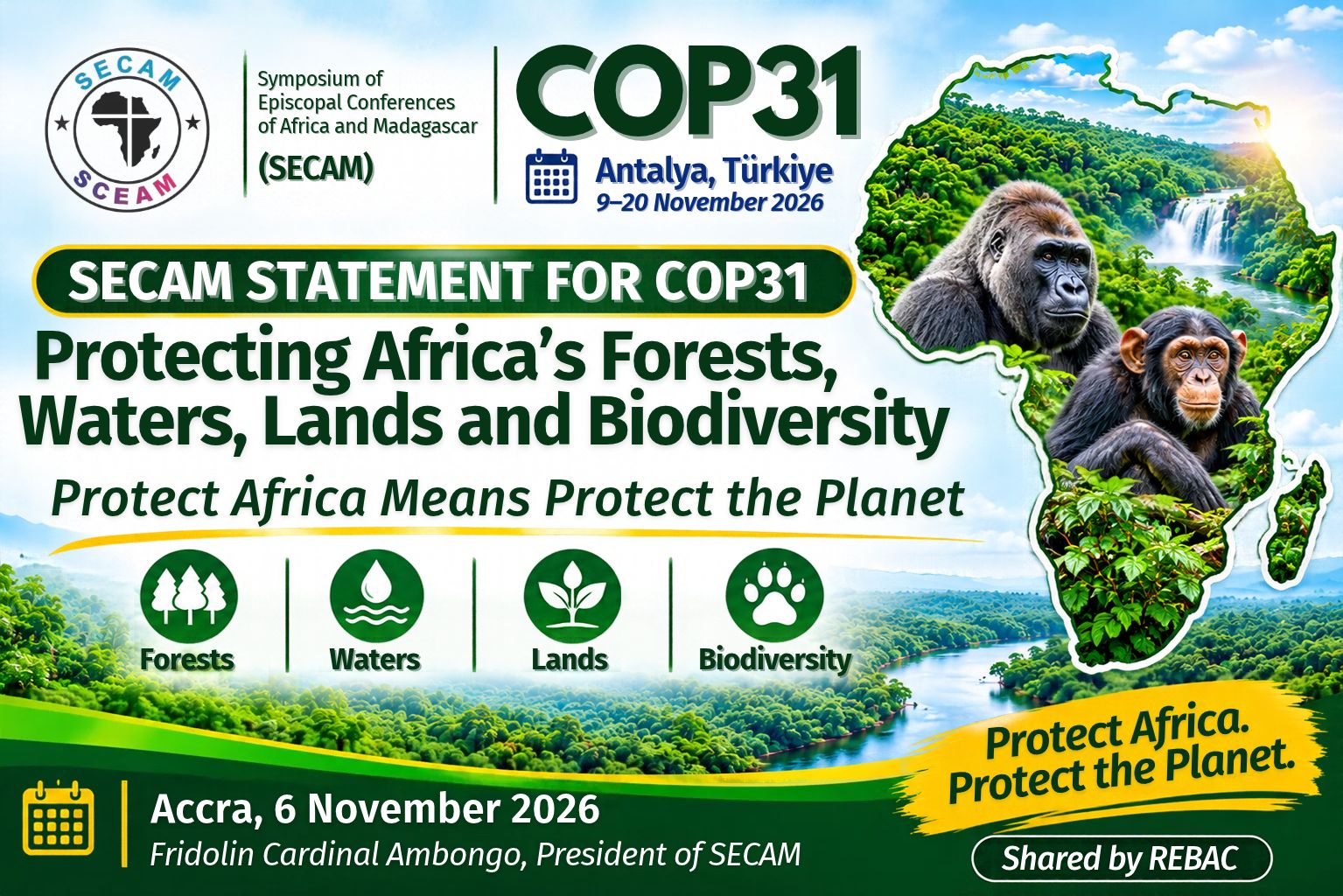
SECAM Statement for COP31
Protecting Africa’s Forests, Waters, Lands, and Biodiversity:
Protecting Africa Means Protecting the Planet
As the Catholic Church in Africa, the Symposium of Episcopal Conferences of Africa and Madagascar (SECAM) calls upon governments, development partners, international financial institutions, businesses, civil society, and all people of good will participating in COP31 to recognize that protecting Africa’s forests, waters, lands, and biodiversity is essential for safeguarding the planet and ensuring a just and sustainable future for present and future generations.
Indeed, Africa is home to ecosystems of global significance. At the heart of this ecological heritage lies the Congo Basin rainforest, the second-largest tropical rainforest in the world and one of the planet’s most vital reservoirs of carbon and biodiversity. Its forests, rivers, wetlands, and peatlands regulate the climate, support livelihoods, foster food and water security, and serve as both a home and a cultural foundation for millions of people. Protecting the Congo Basin is, therefore, not solely Africa’s responsibility; it is a global responsibility.
SECAM is particularly concerned about the interconnected pressures weighing on Africa’s forests and natural resources, including deforestation and forest degradation, the unsustainable exploitation of minerals and timber, agricultural expansion, land degradation, water insecurity, biodiversity loss, pollution, and the impacts of climate change. These pressures disproportionately affect poor and vulnerable communities, including Indigenous peoples, local communities, women, children, and youth, whose livelihoods and well-being depend directly on healthy ecosystems. In the spirit of “Laudato Si’” and the Church’s commitment to integral human development and ecological conversion, SECAM calls for a climate response that places human dignity, ecological integrity, intergenerational justice, and the common good at its center. Africa must not be viewed merely as a source of natural resources or as a recipient of climate aid. African countries and communities must be recognized as essential partners and stewards in the global effort to address the climate and biodiversity crises.
SECAM therefore calls for:
- Enhanced protection of the Congo Basin and Africa’s critical ecosystems including forests, wetlands, peatlands, rivers, savannas, and coastal ecosystems—through effective national, regional, and international cooperation.
- Increased and predictable climate and biodiversity financing for Africa, including grants and highly concessional funding, with resources reaching the national and local levels, as well as the communities that protect these ecosystems and depend upon them.
- Recognition and protection of the rights and participation of Indigenous peoples and local communities, including their land rights, traditional knowledge, livelihoods, and meaningful involvement in decisions affecting their territories and natural resources.
- Responsible and sustainable management of Africa’s natural resources, ensuring that investments in the mining, forestry, agricultural, infrastructure, and other sectors respect environmental safeguards, human rights, and the interests of communities, while contributing to local development.
- Protection of Africa’s water resources, recognizing water as fundamental to human dignity, health, food security, peace, and sustainable development. Water governance must prioritize equitable access, the protection of watersheds, and the resilience of communities facing climate-related water stress.
- Restoration of degraded lands and ecosystems, alongside investments in regenerative agriculture, sustainable livelihoods, nature-based solutions, and locally-led conservation, in order to strengthen both ecological resilience and the well-being of communities.
- Greater accountability from governments, businesses, and financial institutions, including transparent environmental and social safeguards, as well as effective mechanisms that allow communities to participate in decision-making and obtain redress in the event of environmental or social harm.
- A just transition that creates opportunities for young people, women, and vulnerable communities in Africa through green jobs, renewable energy, sustainable businesses, climate-smart agriculture, and other forms of environmentally friendly economic development.
Our Commitment
SECAM is committed to collaborating with the African Union, regional economic communities, national governments, Catholic institutions, Caritas, “Justice and Peace” commissions, religious communities, indigenous peoples and local communities, civil society, the academic world, and international partners to strengthen advocacy, environmental education, community mobilization, responsible ecological stewardship, and climate action across the continent.
Africa’s forests, waters, lands, and biodiversity are not limitless resources. They are part of the “common home” entrusted to humanity. The Congo Basin must be protected, not only for the sake of Africa, but also for the generations that will inherit our planet.
On the occasion of COP31, SECAM calls for solidarity expressed through concrete action, for funding that reaches local communities, for development that respects Creation, and for climate justice that acknowledges both Africa’s contribution and its vulnerability.
Protect Africa’s forests.
Protect Africa’s waters.
Protect Africa’s lands and biodiversity.
Protect Africa and protect the planet.
Accra, 6 November 2026
✠ Fridolin Cardinal Ambongo
Archbishop of Kinshasa
President of SECAM
—
Download | Télécharger|
English: SECAM Statement for COP31
Français: Declaration du SCEAM pour la COP31
Português: Declaracao do SCEAM para a COP31